I’ve heard frequently that one must first know the rules to know how to break them. I agree somewhat: one must not need to be a master of the form to bend the figuration of any medium or genre, but the masters, through their expertise, are usually the trailblazers of those same mediums or genres.
Picasso already painted like this when he was 15, but he’s famous for painting like this instead.
Any weird, niche, experimental or overall avant-garde metal band is composed of extremely well trained musicians.
But, if there is a counter argument to the phrase with which I started this post, that is the existence of outsider art — art made by people that aren’t formally trained and thus usually favor expression over technique.
While one can debate how much of a trailblazer can an outsider artist be in comparison to a master of the form, or, hell, just an expert, their influence is usually a fresh spin on things at the very least. Paul Klee didn’t find fascination in children’s drawings for nothing.
So… both masters and amateurs are going to break the rules anyway, knowing them be damned, and it’s sounding like it’s desirable to do so even, they start sounding more like… advice, rather than ‘rules’, but what’s interesting is that these rules are the product of experimentation and iteration.
Gaming’s trailblazers
Street Fighter II by no means is outsider art, if it isn’t obvious by its incredible graphics and its legendary soundtrack, it should be for the fact that it has II in the title and that its staff had already years of professional experience in the industry. It’s rather a definitive score in favor of the camp that posits that only masters can bend (or, actually, set) the rules.
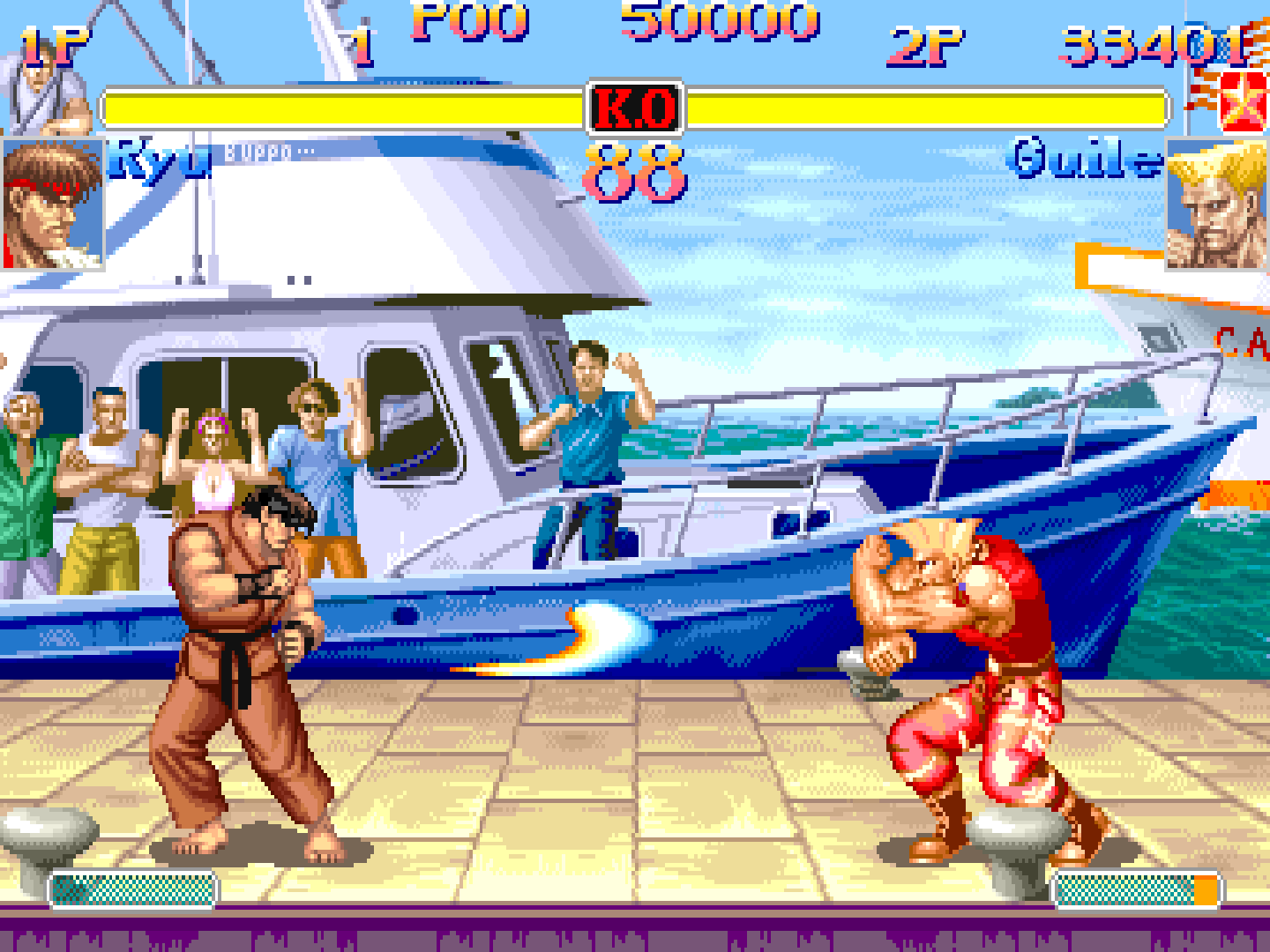
It’s hard for me to think of a more influential videogame. It defined an entire genre. It was so good it didn’t need to be the first fighting game to achieve this.
Its tropes, gameplay feel and rules still echo thirty years later: it introduced the grappler, zoner, rushdown and shoto archetypes, invented charge characters and a variety of motion inputs, made fireballs a core concept of the genre and while it wasn’t the first game to have supers, their form and function is recognizably modern.
It’s also… rough, like early efforts usually are. Street Fighter II is, by no means, outsider art. Some guy doing a Street Fighter II-like in 2026 would come off as an outsider artist though. And including the same stupid shit you can be a victim (or user) of while playing Street Fighter II might elicit a chuckle or two from the OGs, but would just alienate anyone else. Just like outsider art usually does.
One must love the pain
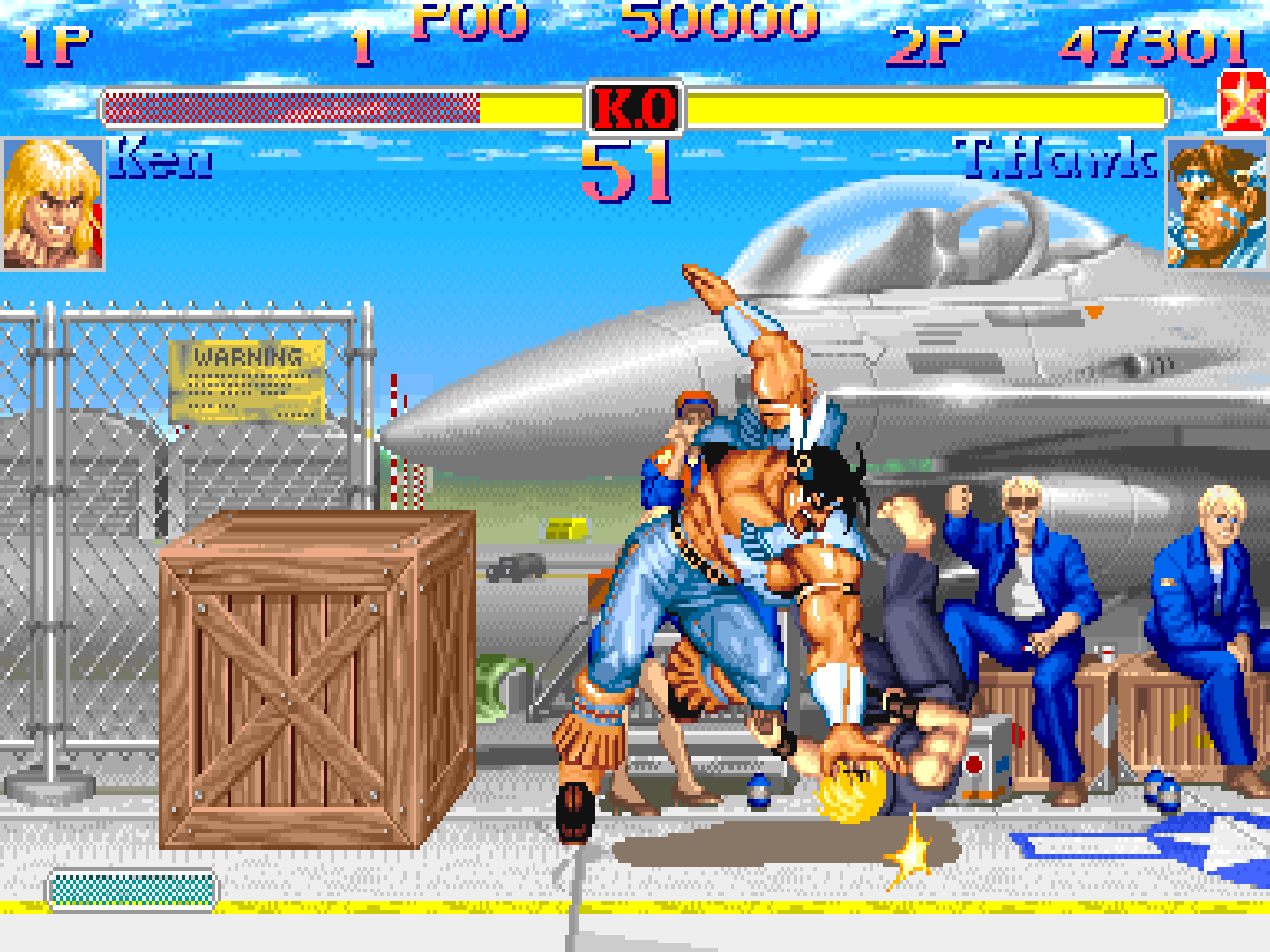
Super Street Fighter II: The New Challengers, the fourth edition of Street Fighter II, introduced a new grappler: T. Hawk. In the surface he’s just another low tier (grapplers being low tiers is also another trope I believe originated from this game) until you notice two things: his command grab1 doesn’t whiff2 and you can perform it by doing the motion and releasing3 the punch button (instead of… doing the motion and pressing the punch button).
If you’re not a fighting game player I might as well be speaking in chinese to you, even if you read the glossary. The only thing you have to be aware of is that this goes against any rules of the genre. If Street Fighter 6 had a (obviously DLC) character that could do this, reddit would be filled in seconds with enraged gamers demanding a nerf. And hey, I know that mocking redditors is fashionable… but I get it.
Well, you might still say to yourself: that sounds like a nothing-burger. An explanation is warranted.
A powerful move not whiffing means a powerful move that you can’t punish — if you play against a T. Hawk player, they’ll never have to worry that them not hitting the command grab will translate in you hitting them.
Zangief (the other grappler character) players do not have this privilege — Zangief’s spinning pile driver does whiff. Now it’s easy to imagine some dudes in the 90’s thinking this was stupid then.
The second thing, that releasing-the-button-instead-of-pressing-it is more subtle.
One must know what the rules allow you to do before…
Fighting games have this thing called option select: a situation where you can cover multiple options your enemy is forced to take (block, do nothing, which is still something by the way, do a reversal) with a single action. What your character (not you, you already did your part) will do is conditioned on what your opponent will do.
This is not the questionable per se, I mean, the rules of the genre don’t see this as something stupid and broken (although I can envision someone getting angry over option selects) — It’s just an option-covering situation that gives an advantage to the attacker, when usually it’s rock-paper-scissors: you do something, your opponent does something and someone will come out on top, while an option select is more like the attacker being able to play two hands of rock-paper-scissors at the same time.
Yes, that two-hands-at-the-same-time analogy still sounds stupid and broken but what you must take into account is that these situations are usually hard to fish out, and in the best games, usually reward ‘lower-tiered’ characters, like grapplers.
What is not normal is option selects leading you to option selects leading you to option selects. That’s what T. Hawk can do by virtue of being able to do his command grab by releasing the button.
Imagine you press light punch, your opponent blocks, but you don’t release the button. Because you’re a good T. Hawk player, you’re already inputting the 360. Your opponent, meanwhile, is stuck in block stun4.
Your opponent is forced to do one of two things:
- Keep blocking
- Input the reversal5 (harder)
Because you’re inputting the 360, by the time your opponent hits the reversal (if they chose to), you’ll block it. Every time. If your opponent keeps blocking, you’ll release your button and grab them. And this is what it plays out, and keep in mind, you’re only doing one thing:
- You punch -> Your opponent blocks. They’re stunned. -> You start inputting the 360-motion -> Your opponent hits their reversal -> You’ll block -> You punish, ideally with a command grab and slam your opponent to the ground -> You hit a meaty6 light punch -> Repeat
- You punch -> Your opponent blocks. They’re stunned. -> You start inputting the 360-motion -> Your opponent blocks -> You hit your command grab and slam your opponent to the ground -> You hit a meaty6 light punch -> Repeat
TL;DR: You trapped your opponent in a death spiral. And only because T. Hawk’s command grab doesn’t whiff and can be done with negative edge. Now you understand why this wouldn’t fly now, specially not amongst the competitive crowd.
And the funny thing is, this isn’t the only thing broken in this game. And that’s Super Turbo. Champion Edition’s M. Bison, I mean Vega, I mean dictator, had an infinite. On block.
One must realize… that there are no rules
Even then, both Super Street Fighter II Turbo and Street Fighter II: Champion Edition have a vibrant competitive community. These titles have cultivated an (on the surface, sadomasochistic) audience that loves them, despite their flaws. Despite… or, actually, in some cases, due to their flaws.
And Street Fighter II isn’t alone in this. Tons of fighting games, made before the rules were set in stone, have entire communities attached to them, with tons of fans playing them religiously to this day.
What wouldn’t fly now, what would be seen as bad design, has allowed emergent gameplay. People have discovered new ways to play that weren’t intended by the developers. That weren’t contemplated, nor defined by the rules — Not the nebulous rules of a genre or even those that the designers came up with to, you know, build the foundation in which the system lays.
They’re usually called glitches and bugs, they usually alienate a large portion of the playerbase, and they usually turn the relationship you may have with a game into a love-it-or-hate-it kind of situation.
SoulCalibur II’s 2G, Capcom vs. SNK 2’s roll cancel, Super Smash Brother’s Melee… whole gist. And believe me, I’m not exaggerating. And Tekken’s korean backdash of course. Also, SoulCalibur has a similar technique.
If developers could patch their games in the 90s and 2000s, and if internet forums of the era exhibited the rage we usually see on current social media, they would do it, they would patch most of the things I mentioned above, well, minus korean backdash, I guess tekken players can lobby well. And SoulCalibur back dash cancelling, I believe you can still do that in the last installment that came… 8 years ago? Jesus..
Emergent gameplay be damned. The rules must be respected. I only hope you can at least appreciate that this isn’t a whim, there’s something there. The people that still play these games aren’t masochistic. The bent rules lying on the floor just come with the package. And they love the package. I do, too.
Glossary
-
A special move that’s a grab. Usually done with a 360-motion input and therefore more powerful than the normal grabs everyone can do. A staple of grapplers. ↩
-
An animation that plays when you miss the attack. It usually leaves you vulnerable. ↩
-
Also called negative edge. ↩
-
An amount of frames after blocking a hit in which you can’t do nothing. ↩
-
An special attack that executes in the first actionable frame and due to its properties is invincible on startup. ↩
-
An attack you hit in the exact moment your opponent is waking up. They’re forced to block, or do a reversal, or they’ll take the damage. ↩ ↩2